IAU Contributes to the Revision of the UNESCO Recommendation on Higher-Education Teaching Personnel
Shaping the Future of Academic Rights and Responsibilities in a Changing World
In the three decades since the adoption of the UNESCO Recommendation concerning the Status of Higher-Education Teaching Personnel (1997), the global higher education landscape has undergone profound transformation. Rapid technological advancements, growing inequalities, climate challenges, and evolving learning environments have reshaped the realities of teaching and research. As the only international standard dedicated to the rights, responsibilities, academic freedom, and professional conditions of higher-education teaching personnel, the 1997 Recommendation remains a vital reference for policies and practices worldwide. Recognizing the need to ensure its continued relevance, UNESCO has initiated a comprehensive revision process—and the International Association of Universities (IAU) is playing a key role.
Why Revise the 1997 Recommendation?
The 1997 Recommendation has served as a cornerstone for higher education, establishing a global framework for academic freedom, institutional autonomy, professional development, and social protections. However, the world has changed dramatically since its adoption. Today, higher education institutions operate in an environment shaped by:
Digital transformation, including the rise of artificial intelligence and new learning modalities
Climate change and demographic shifts, impacting institutional stability and educational priorities
Widening inequalities and discrimination, affecting access and equity in higher education
Evolving societal expectations, with greater emphasis on sustainable development and global citizenship
Pressures on academic freedom, amid geopolitical tensions and changing governance models
With over 22,000 accredited higher education institutions worldwide, the need for an updated, responsive framework has never been more urgent. The revision aims to ensure the Recommendation reflects contemporary realities, addresses emerging challenges, and strengthens teaching and research as respected, protected, and collaborative professions.
The IAU’s Role in the Revision Process
The IAU is actively contributing to this historic effort by convening an international consultation group to provide expertise and diverse perspectives. The IAU international consultation group includes:
Haifa Jamal Al-Lail, President, Effat University, Saudi Arabia
Peter Aronsson, Vice-Chancellor, Linnaeus University, Sweden
Henk Kummeling, Former Rector Magnificus, Utrecht University, The Netherlands
Liviu Matei, Head of the King's School of Education, Communication & Society (ECS), King’s College London, UK
Pankaj Mittal, Secretary General, Association of Indian Universities, India
Vincent Ogutu, Vice-Chancellor, Strathmore University, Kenya
David Quigley, Provost and Dean of Faculties, Boston College, USA
Miki Sugimura, President, Sophia University, Japan
Renée T. White, Former Provost, The New School, USA and IAU Senior Fellow
IAU Secretariat representatives: Hilligje van’t Land, Secretary General; Andreas Corcoran, Deputy Secretary General; Margaret Harris, Communications and Media Officer.
This input will directly inform the work of the UNESCO Independent Expert Group (IEG-97), the body tasked with drafting the revised Recommendation.
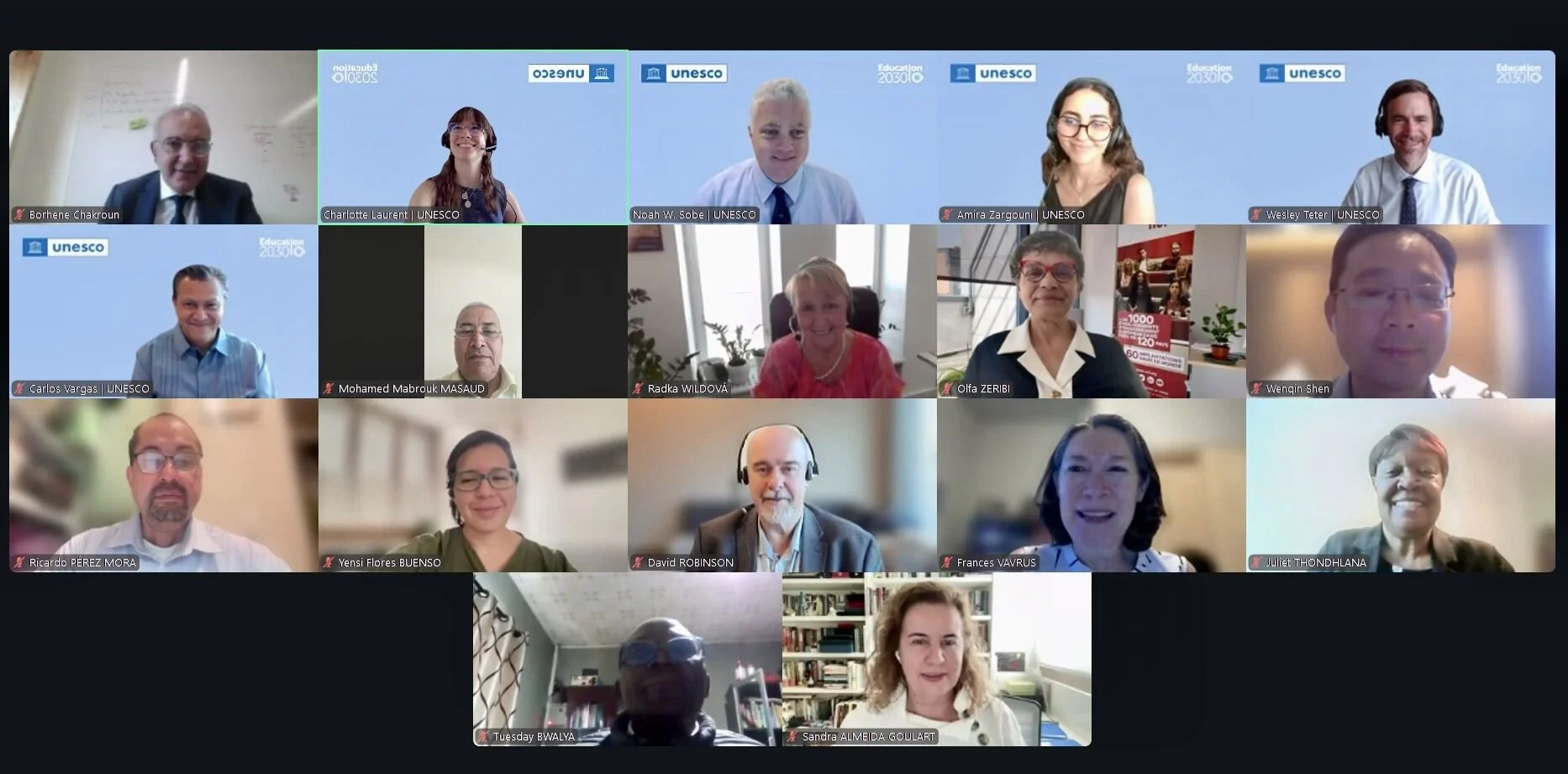
First meeting of the IEG-97 in June 2026
The IAU is represented on the IEG-97 by Board Member Sandra Regina Goulart Almeida, President of the Federal University of Minas Gerais, Brazil. Her participation ensures that the global higher education community’s voice is heard in the technical phase of the revision, which began in June 2026.
The revision process is structured in three phases:
Preparation (Q4 2025): Evidence review and background research
Technical Consultations (2026): IEG-97 meetings to advise on revisions
Formal Consultations and Adoption (Q3 2026–Q4 2027): Member State consultations, approval by a special committee, and final adoption by the UNESCO General Conference at its 44th session in 2027
A Global Effort for a Global Framework
The revision of the 1997 Recommendation is part of a broader UNESCO initiative to update both the 1966 Recommendation concerning the Status of Teachers and the 1997 Recommendation. This dual process recognizes that teachers at all levels—from early childhood to higher education—are navigating rapidly changing professional environments.
UNESCO’s 43 C/73 Resolution called for these revisions to ensure the instruments reflect today’s challenges and strengthen teaching as a respected, protected, and collaborative profession. The process emphasizes transparency, inclusiveness, and broad engagement, with opportunities for stakeholders worldwide to contribute.