Launch of the 4th IAU Global Survey on HESD
Higher Education as a Catalyst for Sustainable Transformation
The IAU was pleased to launch the 4th Global Survey on Higher Education and Research for Sustainable Development in February 2026.
Under the Higher Education and Research for Sustainable Development (HESD) priority area, the IAU conducts comprehensive global surveys on HESD every four years, serving as a cornerstone for understanding and advancing sustainable practices in higher education worldwide. These surveys delve into diverse aspects of sustainability within higher education institutions (HEIs), capturing insights on curriculum integration, institutional policies, and community engagement initiatives.
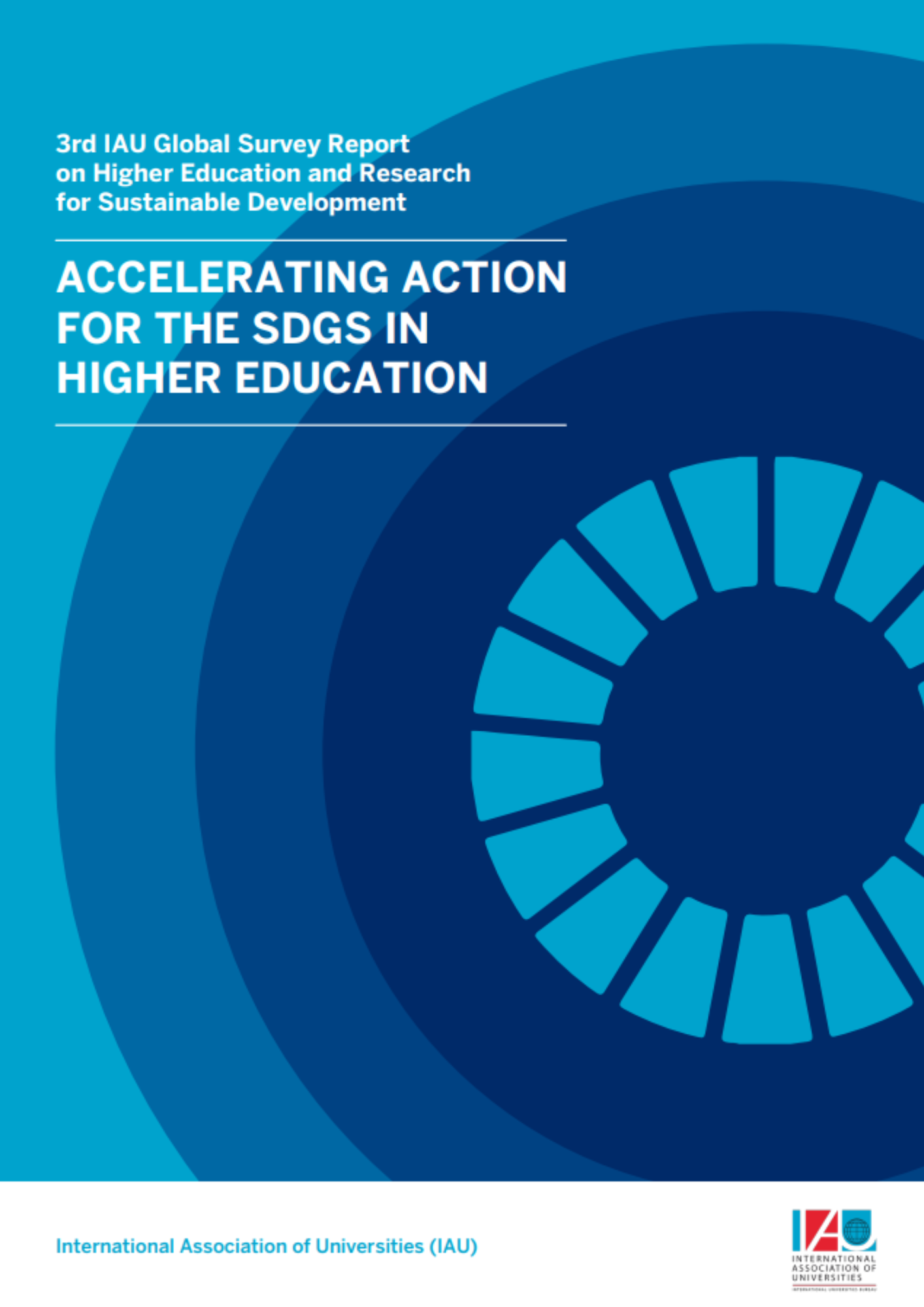
3rd IAU Global Survey on HESD
Through rigorous data collection and analysis, the IAU's global surveys offer invaluable insights into the current landscape of HESD, informing strategic decision-making and fostering collaborative efforts towards a more sustainable future for higher education institutions globally. Furthermore, the survey includes questions on key frameworks such as the 2030 Agenda and the Sustainable Development Goals (SDGs), aiming to deepen understanding of how HEIs engage with sustainable development (SD) in a holistic manner.
Now in its fourth edition, this global survey will provide valuable insights into the progress made and the ongoing challenges in advancing SD. It also seeks to inspire universities worldwide to continue and expand their contributions to the SDGs and to a more sustainable and just future.
The findings will serve as a resource for HEIs already active in this area, as well as those seeking to strengthen their engagement. The results will moreover reinforce advocacy efforts that underscore the essential role of higher education at both the global and national levels, in line with the IAU’s strategic priority on Higher Education and Research for Sustainable Development (HESD).
Survey Questionnaire:
The 4th IAU Global Survey on HESD has now closed for submissions. PDF copies of the survey questionaire are availble to download in English, French, and Spanish.
Survey Partners
The IAU extends its thanks to partners of the 4th IAU HESD Survey for their support of this project and sharing of expertise (in alphabetical order):
Académie de Recherche et d’Enseignement Supérieur (ARES)
Asia-Europe Foundation (ASEF)
Association of African Universities (AAU)
Association of Arab Universities (AARU)
Association of Commonwealth Universities (ACU)
Conference of Rectors of Spanish Universities(Conferencia de Rectores de las Universidades Españolas) (CRUE)
Environmental Association for Universities and Colleges (EUAC)
European University Association (EUA)
German Rectors’ Conference(Hochschulrektorenkonferenz) (HRK)
Global Student Forum (GSF)
Qatar Foundation (QF)
Students Organising for Sustainability (SOS)
Unión de Universidades de América Latina y el Caribe (UDUALC)
Timeline
September - December 2025: Survey Preparations
The IAU invited partner organisations on board and put together an Expert Advisory Group with representatives from organisations and higher education experts from all over the world. The advisory group helped improve the questionnaire and pilot the survey in a small test group.
Mid February 2026: Survey launch
The survey will be launched online in mid February 2026. It will be shared amongst IAU Members, institutions listed in the World Higher Education Database (WHED), IAU social media channels, and IAU partner organisations.
February - June 2026: Data collection
Data waa collected globally between February and April 2026, with the objective of achieving a balanced regional distribution of responses. The survey was administered online and disseminated through institutional networks and partner organizations to ensure broad geographic coverage and representation across regions.
June - December 2026: Data analysis and report drafting
Survey responses will be reviewed, analysed, and synthesised to identify key trends. Based on the data analysis, the results will be presented and discussed in a comprehensive report. Preliminary findings might be shared at selected key events, such as the IAU 17th General Conference, with the aim of informing policy discussions.
Early 2027: Survey report publication
The final survey report is expected to be published in early 2027.